Business relationships between Autonomous Systems (ASes) are typically
confidential, so they must be inferred from data that is publicly
available. This page explains, step by step, the algorithm CAIDA uses to
infer those relationships from public BGP paths, and how the inferred
relationships are then used to compute each AS's
customer cone and
rank.
This page focuses on the algorithm itself; for background on what
relationships, degrees, and customer cones are, see the
about page or the paper
AS Relationships, Customer Cones, and Validation
.
The algorithm classifies each observed link between two ASes as one of two
relationship types:
- customer-to-provider (c2p / p2c): the customer obtains
transit from the provider to reach the rest of the Internet, and
- peer-to-peer (p2p): the two ASes exchange traffic between
themselves and their customers, typically settlement-free.
The algorithm rests on three assumptions about the structure of the
Internet:
- An AS enters into a provider relationship to become globally
reachable. A provider announces its customers' routes to its own
providers and peers, so at least one vantage point should observe a
provider announcing its customer's routes.
- There exists a clique of large transit providers at the top of
the hierarchy. These ASes peer with each other in a full mesh so
that their customers (and their customers' customers) obtain global
connectivity.
The full pipeline runs in the following stages, each explained in a
section below:
- Collect BGP paths and clean them of loops,
poisoned paths, unassigned ASes, and IXP route servers.
- Sort ASes into the top-down order in which their relationships
will be inferred, with the clique at the
top.
- Infer relationships in eight steps: the
clique's peering mesh first, then c2p links from strongest to weakest
evidence, and finally p2p for every link that remains.
- Compute each AS's customer cone from the
inferred relationships and the observed paths.
- Rank ASes by the size of their customer
cones.
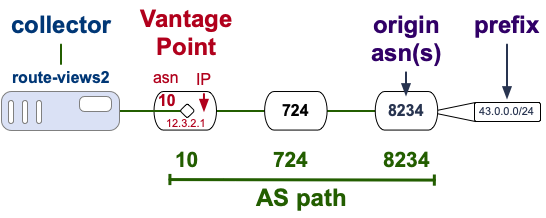
The input to the algorithm is the set of AS paths extracted from BGP
routing table snapshots collected by the
Route Views project and
RIPE's Routing
Information Service (RIS). Each BGP peer that supplies routes to a
collector is a vantage point (VP): it shows an AS-level view of the
Internet from that peer's perspective, and it appears as the first AS on
the left of every path it supplies. Paths containing AS-sets are
discarded, and path padding is compressed (a path "A B B C" becomes
"A B C").
Raw BGP paths contain artifacts that would corrupt relationship
inference, so paths are first cleaned:
- Loops: paths where an AS appears more than once, separated
by at least one other AS, are discarded. Such loops indicate
path poisoning, where an AS inserts another AS into a path to
prevent that AS from selecting the route. A poisoned path implies a
link between two ASes where in reality none may exist.
Example: 64496 3356 64497 3356
— AS3356 appears twice, separated by AS64497, so the path is
discarded.
- Separated clique ASes: paths where two
clique ASes are separated by a non-clique AS are
discarded. A clique AS is by definition transit-free, so this
condition also indicates poisoning.
Example: 64496 3356 64497 1239
— 3356 and 1239 are both clique ASes, but a non-clique AS64497
sits between them, so the path is discarded.
- Unassigned ASes: paths containing AS numbers not assigned
by IANA to any organization are discarded, since these ASes should
not be routed on the Internet.
Example: 64496 23456 1239
— AS23456 is a reserved, special-purpose ASN (used to let old
routers that only understand 2-byte ASNs interoperate with 4-byte
ASNs) and should never appear in a real path, so it is discarded.
- IXP route servers: ASes operated by Internet Exchange
Point route servers are removed from paths, so that the exchange's
participants — who hold the actual relationship — appear
adjacent in the path.
Example: 64496 64500 1239 becomes
64496 1239 — AS64500 is an IXP route server, so it
is removed and the two exchange participants become adjacent.
After cleaning, the algorithm computes each AS's node degree and
transit degree, and sorts all ASes
into the order in which their relationships will be inferred: clique ASes
first, then all other ASes by decreasing transit degree, breaking ties by
node degree and then by AS number. Sorting by transit degree rather than
node degree avoids mistaking high-degree ASes that provide no transit
(for example, content providers with many peers) for transit providers.
This top-down order matters: c2p relationships are inferred along
the degree gradient, which is also what prevents cycles of c2p links from
forming.
The clique is the set of large transit providers at the top of the
hierarchy. Clique ASes are transit-free: they have no providers,
and instead maintain a full mesh of settlement-free peering with each
other, which gives their customers global reachability. The clique
anchors the whole inference: its members are placed at the top of the
top-down order, its internal links are the first relationships assigned
(Step 1), and paths crossing the clique provide the
initial evidence from which c2p relationships propagate downward.
The algorithm uses the following set of settlement-free peers as the
clique:
174, 209, 286, 701, 1239, 1299, 2828, 2914, 3257, 3320, 3356, 3491,
5511, 6453, 6461, 6762, 6830, 7018, 12956
With clean paths, degrees, and the clique in hand, the algorithm infers a
relationship for every observed link in eight steps. Steps 2 through 7
infer c2p links, ordered from the strongest evidence to the weakest;
Step 8 classifies everything that remains as p2p. These are the same
step numbers used in the per-link inference reports elsewhere on this
site.
AS path triplets. Most steps make inferences using AS path
triplets: three consecutive ASes in a path, i.e. an adjacent pair
of links. Triplets provide the constraints needed to infer c2p
relationships while allowing the algorithm to ignore non-hierarchical
segments elsewhere in a path. For example, the path
"1239 3356 9002 6846" contains two triplets: "1239 3356 9002" and
"3356 9002 6846". A triplet "X Y Z" is read from the vantage point
outward: the route was announced by Z to Y, and by Y onward to X. In
other words, Y is forwarding Z's routes to X — and since an AS only
announces its customers' routes to its providers and peers, seeing
Y announce Z's routes to a known provider or peer of Y is evidence that Z
is a customer of Y. This observation is the engine of the whole
algorithm.
Notation. In the tables and text below, "X → Y" means X is
inferred to be a provider of Y (a p2c link), and "X – Y"
means X and Y are inferred to be peers (a p2p link).
Preventing cycles. Whenever a c2p relationship is inferred, the
customer is recorded in the customer cone of the provider and of all the
provider's upstream providers. The algorithm never infers a c2p
relationship where the would-be provider is already in the would-be
customer's cone, so no cycle of c2p links can form.
Every pair of ASes in the clique is assigned a p2p
relationship — a full mesh of settlement-free peering. This
follows directly from the second assumption: clique members are
transit-free and obtain connectivity to each other by peering. No paths
are used by this step; it simply encodes the clique.
This is responsible for roughly 90% of
all c2p inferences. ASes are visited in the top-down order established
earlier, skipping clique ASes (which have no providers). When visiting
AS Z, the algorithm examines each of Z's neighbors Y and infers
Y → Z if it observes a triplet "X Y Z" where X is already
known to be a provider or peer of Y. The reasoning: Y announced Z's
routes upward to its provider or peer X, and an AS only announces
customer routes upward, so Z must be Y's customer. Peer evidence that is
not corroborated by upstream announcements is only trusted when observed
repeatedly (more than twice).
The order of ASes within the triplet matters. To minimize false c2p
inferences caused by route leaks (an AS mistakenly announcing provider or
peer routes to a peer), the provider or peer must be observed
closer to a vantage point than the customer in at least one
triplet. This builds on the first assumption: an AS enters a provider
relationship to become globally reachable, so at least one VP should see
the provider announcing the customer's routes.
Because Z's inferred providers all have a larger transit degree than Z
(they were visited earlier in the top-down order), c2p links are assigned
along the degree gradient and no c2p cycle can form.
Some vantage points supply routes to only a small fraction of the
Internet. The algorithm treats VPs that provide routes to fewer than 2%
of all ASes as partial VPs: they have either configured their BGP
session with the collector as p2p (exporting only customer routes), or
configured it as p2c while holding a default route to their provider.
Either way, the routes they export are customer routes.
For each path of exactly three ASes "VP Y Z" supplied by a partial VP,
where Z is a stub (an AS with transit degree zero) and the Y–Z
link is still unresolved, the algorithm infers Y → Z. The
link between the VP and Y may be either p2c or p2p, but in both cases Y
would only announce Z's routes to the VP if Z were Y's customer.
Step 2 infers providers along the transit-degree gradient, so it misses
c2p relationships where the provider has a smaller transit degree
than its customer. These do occur — for example, a large content
network obtaining transit from a small regional provider. Given an AS Y
with a known provider X, and a neighbor Z of Y whose transit degree is at
least as large as Y's, the algorithm infers Y → Z when both:
- a triplet "X Y Z" is observed (Y announces Z's routes to its
provider X), and
- at least one path ends with "X Y Z", i.e. Z originates a
prefix that is announced through Y to X.
The second condition guards against path poisoning: poisoned path
segments do not announce address space, so requiring Z to originate a
prefix ensures the link is real. Because inferences against the degree
gradient carry more risk, the evidence must be observed at least three
times. After inferring Y → Z, the inference cascades: neighbors of
Z observed downstream of "Y Z" become customers of Z under the same
logic.
Steps 2 and 4 both require an AS to already have a provider or peer
before its customers can be identified. Some ASes have no providers at
all yet are not in the clique — typically large regional or
research networks. The algorithm visits each AS X that still has no
inferred provider, is not in the clique, and has a transit degree of at
least 10, and examines triplets "W X Y" with X in the middle:
- W – X: W is inferred to be a peer of X, because in
all the earlier steps W was never observed announcing X's routes to a
provider or peer — if W were X's provider, it would have
been.
- X → Y: X announces Y's routes to W, so Y is X's
customer. As in step 4, the inference cascades to neighbors of Y
observed further downstream.
Unlike step 2, this step does not require the peer to be observed closest
to a VP, because provider-less ASes are mostly observed through
downstream customers that provide a public BGP view.
If a link is observed between a stub AS (transit degree zero) and a
clique AS and no relationship has been inferred for it, the clique AS is
inferred to be the provider of the stub. Step 2 could only have
classified this link if a route crossing it had been observed by another
clique AS, which does not always happen — for example, when the
link is a backup transit relationship. Stub networks are extremely
unlikely to meet the peering requirements of clique members, so a
customer relationship is by far the most likely explanation. No triplet
is used; the inference is purely topological.
At this point some triplets "X ? Y ? Z" remain in which neither
link has a relationship. If both were left to become p2p in step 8, the
result would be two adjacent p2p links — which implies anomalous
behavior such as free transit or route leakage, since an AS does not
announce routes learned from one peer to another peer. To avoid this,
ASes are traversed top-down one final time, and for each unresolved
triplet "X ? Y ? Z" the algorithm attempts to resolve one side as p2c,
inferring Y → Z (with X – Y then following in step 8).
If other triplets involving X and Y suggest a conflicting orientation
(evidence that Y is instead X's provider, or that X is Y's customer via
some other neighbor), the algorithm is no longer confident which side of
the triplet is the p2c link and makes no inference, leaving both links to
step 8.
Every link that still has no inferred relationship is classified as p2p.
No triggering pattern is required — these are simply the links for
which steps 1–7 found no evidence of a transit relationship.
The following example, adapted from our
IMC 2013
paper, traces the algorithm over a small set of BGP paths. Four of
the ASes involved (3356, 701, 6461, and 1239) are clique members. Three
ASes provide the vantage points: 1239, 9002, and 15169; each appears as
the leftmost AS of the paths it supplies. AS 15169 supplies routes to
only a small fraction of ASes, so it is treated as a
partial VP.
| # | BGP path |
|---|
| 1 | 1239 3356 9002 6846 |
| 2 | 1239 13395 |
| 3 | 1239 15169 6432 |
| 4 | 3356 1239 721 |
| 5 | 1239 721 27065 |
| 6 | 1239 721 27065 2629 |
| 7 | 9002 3356 1239 |
| 8 | 9002 11164 2152 7377 |
| 9 | 15169 6432 36040 |
The ASes are sorted top-down: the clique members first, then the rest by
decreasing transit degree:
3356, 701, 6461, 1239, 9002, 15169, 11164, 2152, 27065, 6846, 721,
7377, 6432, 2629, 13395, 36040
The algorithm then makes the following inferences. Recall that
"X → Y" means X is inferred to be a provider of Y, and
"X – Y" means X and Y are inferred to be peers.
| Step | Inference | Why |
|---|
| 1 |
3356 – 701 – 6461 – 1239 (full mesh) |
All four are clique members, so every pair is assigned p2p. |
| 2 |
3356 → 9002 |
Triplet "1239 3356 9002" (path 1): 3356 announces 9002's routes
to its peer 1239, so 9002 is 3356's customer. Note the algorithm
uses path 1, where 3356 is closer to the VP than 9002, and not
path 7, where the order is reversed. |
| 2 |
9002 → 6846 |
Triplet "3356 9002 6846" (path 1): 9002 announces 6846's routes
to its now-known provider 3356. |
| 2 |
1239 → 721 |
Triplet "3356 1239 721" (path 4): 1239 announces 721's routes to
its peer 3356. |
| 3 |
6432 → 36040 |
Path 9 has exactly three ASes, its VP 15169 is a partial VP, and
36040 is a stub, so 6432 must be 36040's provider. |
| 4 |
721 → 27065 |
721 (transit degree 6) has provider 1239, and its neighbor 27065
(transit degree 34) has the larger transit degree. Path 5 ends with
"1239 721 27065", showing 27065 originating a prefix through 721, so
the link is real and 27065 is 721's customer. |
| 4 |
27065 → 2629 |
Cascade of the previous inference: path 6 shows 2629 downstream
of "721 27065". |
| 5 |
9002 – 11164 |
11164 has no inferred provider and is not in the clique. Triplet
"9002 11164 2152" (path 8) has 11164 in the middle, and 9002 was
never observed announcing 11164's routes upward, so they are
peers. |
| 5 |
11164 → 2152 |
Same triplet: 11164 announces 2152's routes to 9002, so 2152 is
11164's customer. |
| 5 |
2152 → 7377 |
Cascade: triplet "11164 2152 7377" (path 8) shows 7377 downstream
of the new p2c link. |
| 6 |
1239 → 13395 |
Path 2 reveals a link between clique member 1239 and stub 13395,
but no triplet contains that link (perhaps a backup transit
relationship), so it survived to this step and is classified
c2p. |
| 7 |
15169 → 6432 |
In triplet "1239 15169 6432" (path 3), neither link has a
relationship yet. To avoid two adjacent p2p links, the far side is
resolved as p2c: 15169 is 6432's provider. |
| 8 |
1239 – 9002, 1239 – 15169 |
The remaining unclassified links are assigned p2p. |
With every link classified, the algorithm computes each AS's
customer cone: the set of
ASes it can reach by following only p2c (customer) links. This sounds
simple, but there is more than one way to compute it, and the choice
matters:
- Recursive: follow p2c links transitively through the
graph — A's cone contains A's customers, their customers, and
so on. This over-counts, because it assumes a provider receives (and
can reach) all of its customers' routes. In reality a
customer may announce only some prefixes to a given provider, so the
provider cannot necessarily reach everything below that
customer.
- BGP observed: include C in A's cone only if some observed
BGP path actually reaches C from A by a sequence of p2c links. This
avoids the over-counting, but inflates the cones of ASes that host a
vantage point, since far more paths are observed from them than from
other ASes.
- Provider/peer observed: compute A's cone using only the
routes observed from A's providers and peers. Since an AS
announces only its customers' routes to its providers and peers,
anything they are observed reaching through A must be in A's customer
cone. This method avoids both problems above, and it is the method
used to compute the customer cones on this site.
The provider/peer observed method can underestimate a cone, because
public BGP data contains only the best path selected by each AS rather
than all paths. We accept this limitation because the alternative
methods systematically inflate cones, and inflated cones distort the
comparison between ASes that host vantage points and the vast majority
that do not.
Finally, ASes are ranked by the size of their customer cones: an AS's
rank is one greater than the number of ASes with larger customer cones,
so ASes with equally large cones share the same rank. See the
about page for a worked example of
the ranking rule.
- The about page provides
background on AS relationships, degrees, and customer cones.
- The algorithm, its validation (99.6% of c2p and 98.7% of p2p
inferences confirmed correct against ground truth), and the customer
cone analysis are described in full detail in our IMC 2013 paper:
M. Luckie, B. Huffaker, k. claffy, A. Dhamdhere, and V. Giotsas,
"AS
Relationships, Customer Cones, and Validation".
- The inferred relationships are published monthly in CAIDA's
AS
Relationships dataset.